
Hyaluronic Attraction Syndrome: Diagnosis and Modern Treatment Options
The macula is the most sensitive part of the retina, responsible for central, detailed vision (reading, face recognition). Vitreoretinal traction syndrome is caused when the vitreous (the transparent gel of the eye) shrinks and, instead of detaching smoothly, remains stuck to the macula, exerting strong mechanical pulls on it
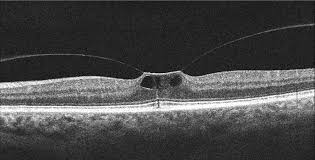
Diagnosis & Quantification
Early diagnosis is critical to prevent permanent damage. In our practice we use:
Optical coherence tomography (OCT): The basic examination that visualizes at the micrometer level the “pulling” of the retina and any accumulation of fluid.
Fluorescein angiography: To assess blood flow and vascular leakage in the area.

Therapeutic Strategy
Treatment is individualised depending on the severity:
Watchful Waiting: If vision is not affected, regular check-ups are recommended.
Pharmaceutical Treatment (Jetrea): Use of an injectable preparation (ocryplasmin) that helps to chemically dissolve the traction, often avoiding surgery.
Microsurgery (Hyalonectomy): A painless procedure under local anesthesia, where the surgeon removes the vitreous and the membranes that cause the traction, releasing the macula.
Frequently Asked Questions
How soon will my vision improve after the surgery?;
Recovery is not instantaneous. Because the macula is a very thin tissue, it takes time to “flatten out” and recover after it is released from the traction. Improvement is gradual and can take from a few weeks to months.
What is Jetrea and how does it help?;
Jetrea (Ocriplasmin) is an enzyme that is injected into the inside of the eye. Its job is to break down the proteins that keep the vitreous attached to the macula. If the traction is loosened by the injection, the patient is spared surgery.
Does the vitrectomy hurt?;
Not at all. The procedure is performed under local anaesthesia and the patient is awake but comfortable. We use extremely thin instruments that do not require stitches, so postoperative discomfort is minimal.
Why did the doctor just tell me to "keep an eye on it"?;
In many cases, the attraction is mild and does not affect the patient's daily life. Because the vitreous continues to shrink, there is a possibility that the traction will resolve on its own (spontaneous resolution). At this stage, OCT monitoring is the safest option.
What happens if I do nothing?;
If the traction is strong and left untreated, it can cause permanent deformation of the macula, fluid collection (swelling) or even the creation of a hole in the macula, leading to permanent loss of central vision.
How often should I have an OCT?;
This depends on the gravity of the attraction. Usually the check is done every 3 or 6 months. The OCT scan is the only way to accurately measure if the ulcer is getting worse or if the macula is starting to lift.