
Dacryocystitis: Infection of the Drainage Canal of the Tears
What is Dacryocystitis?;
It is an inflammation of the lacrimal sac, which occurs as a result of an obstruction of the nasolacrimal duct. The stagnation of tears creates a favourable environment for microbial growth, leading to acute or chronic infection.
Etiopathogenesis
Neogens: It is often due to incomplete opening of the Hasner's valve (congenital obstruction).
Adults: It can be caused by trauma, chronic rhinitis, anatomical narrowing or inflammation of the nasal passages.
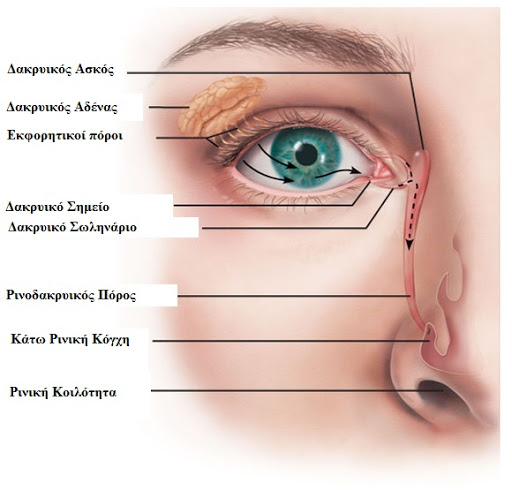
Diagnostic & Therapeutic Approach
Diagnosis is based on clinical examination and bag pressure for pus reflux testing (culture taking).
Conservative Treatment: Administration of antibiotics (topical or systemic) and application of hot compresses. In infants, the Crigler massage technique is applied.
Surgical Treatment: In cases of persistent obstruction, catheterisation of the lacrimal duct or nasolacrimal cystostomy (DCR) is performed to create a new communication channel with the nose.

What about babies?;
Many babies are born with a narrow tear duct, which is why they cry often. In most cases, the problem resolves itself as the child grows older. The doctor will show you how to give a special, gentle massage on the side of the tear duct to help the duct open.
What are the main symptoms?;
Intense swelling and redness in the inner corner of the eye.
Constant tearfulness.
Pony or many tweezers on the eyelashes.
Pain and tenderness at the site of the swelling.
Frequently Asked Questions
Is lacryocystitis dangerous?;
If left untreated, the infection can spread to the surrounding facial tissues (cellulitis). Especially in newborns and the elderly, early initiation of antibiotics is essential to prevent the spread of inflammation.
How does massage help the area?;
Massage (especially in infants) applies hydrostatic pressure inside the tear sac. This pressure can “push” the blockage that is clogging the duct and force it to open naturally.
Will my child need surgery?;
Most infants (over 90%) are treated on their own by the first year of life. If the problem persists after 10-12 months, the ophthalmologist may recommend a simple procedure (catheterization) to clear the blockage.
Why does lacrimal cystitis usually only occur in one eye?;
Because it is usually due to a local anatomical narrowing or blockage of the duct in the particular eye. However, in infants it is not uncommon to be seen in both eyes at the same time.
Can the "congestion" in the nose cause lacrimal cystitis?;
Yes. Because the lacrimal duct ends in the nose, severe inflammation or anatomical problems in the nose (e.g. a crooked septum) can block the flow of tears and lead to infection.
What should I look out for if I have chronic lacrimocystitis?;
If the problem recurs, you should avoid pushing the swelling yourself to get the pus out, as you may injure the tissue. The permanent solution in adults is usually an operation (DCR) that bypasses the blockage.