
Diabetic macular edema: Modern Therapeutic Approach
Diabetic macular edema is caused by the leakage of fluid and plasma components into the retinal layers. Ongoing hyperglycemia increases levels of the factor VEGF, which causes hyperpermeability of the blood vessels, leading to swelling in the centre of vision.
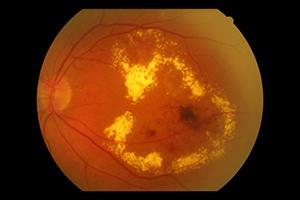
Symptoms & Effects
Without treatment, over 50% of patients will experience significant vision loss within two years. The main symptoms include:
Blurred central vision and image distortion.
Reduced colour perception and sensitivity to light (photophobia).
Appearance of dark spots in the field of vision.
The Revolution of Anti-VEGF Therapies
While the Laser (Argon Laser) remains a tool in our treatment, the intravaginal injections are now the first line of response:
Eylea (Aflibersept): It blocks the activity of VEGF factors, stops leakage and often improves vision.
Protocol: Usually 5 monthly doses and then one injection every 2 months.
Lucentis (Ranibizumab): Inhibits VEGF-A, stabilizing vision.
Protocol: Monthly administration until maximum and stable visual acuity is achieved for 3 consecutive months.
Diagnosis & Monitoring
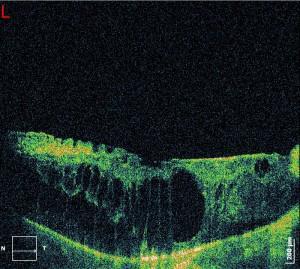
The monitoring is done by Optical Coherence Tomography (OCT), which accurately measures the thickness of the swelling and guides the doctor in personalising the treatment.
What should you watch out for?;
Your vision is directly related to your general health. The main risk factors are:
Elevated glycosylated haemoglobin (HbA1c).
Arterial hypertension and elevated cholesterol.
Smoking.
The importance of consistency
Eye injections sound alarming, but they are quick and painless. The success of the treatment depends on consistency in your appointments. Each dose works cumulatively to “dry out” the eye and maintain your independence.
Frequently Asked Questions
How will I know if treatment with Eylea or Lucentis is working?;
The most objective way is the OCT examination. You will see on the computer screen the “mountain” of edema subsiding and the retina regaining its normal thickness. At the same time, you will feel the blurring decrease and the letters become sharper.
Why do I have to have so many injections?;
Diabetes is a chronic condition. Your body continues to produce the factors (VEGF) that cause swelling. Injections act as a “brake” on this process. Once the swelling has stabilized, the doctor can dilute the doses.
What is the difference between Laser and Injections?;
The laser “seals” the vessels permanently, but may leave small blind spots on the periphery. Injections treat the problem chemically, without causing permanent tissue damage, and are more effective in improving central vision.
Does Lucentis or Eylea injection hurt?;
No. We use special anaesthetic drops and very fine needles. The procedure takes a few seconds and most patients report only a mild sensation of pressure.
What happens if I stop treatment as soon as I see improvement?;
There is a high risk of the fluid coming back (recurrence). Treatment is only stopped when vision and retinal thickness remain stable for at least 3 consecutive months, according to the ophthalmologist's judgment.
Can swelling affect both eyes?;
Yes, because diabetes is a systemic disease, it usually affects both eyes, although not always to the same extent. Regular funduscopy in both eyes is essential.