
Stargardt Disease: the Juvenile Macular Degeneration
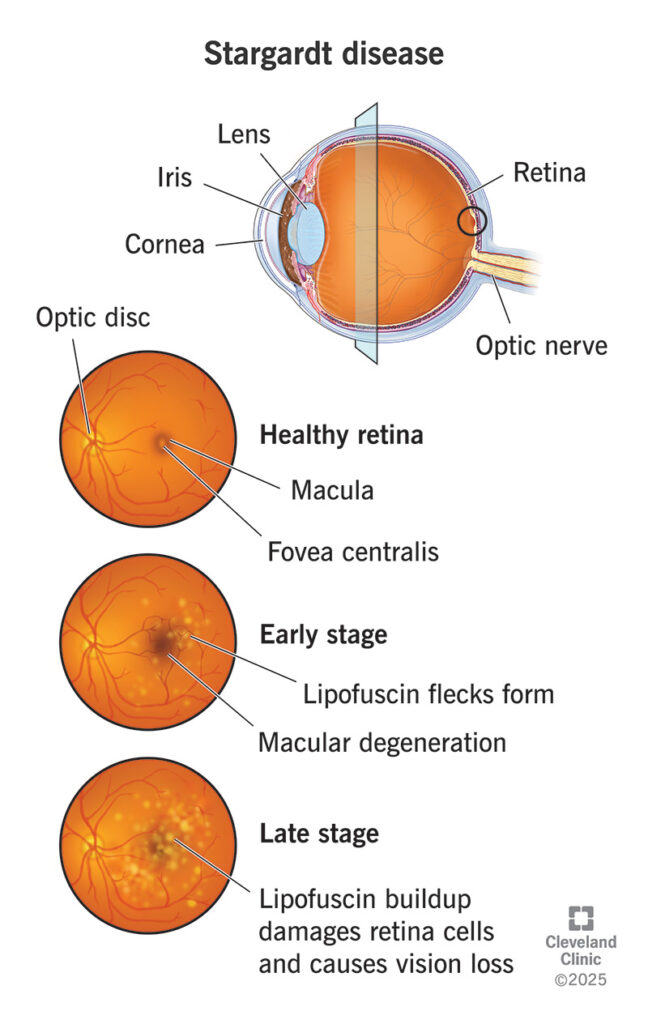
It is an inherited disorder that affects the macula, the area of the retina responsible for central and detailed vision. The disease is caused by the accumulation of fatty deposits (lipofuscin) in the macular cells, leading to their gradual degeneration.
Heredity & Diagnosis
The disease usually follows a recessive inheritance pattern, which means that a child can get the disease if both parents carry the mutation, even if they themselves do not show symptoms. Diagnosis is usually made before the age of 20, when there is an unexplained decline in central vision.
What are the first symptoms?;
Difficulty adjusting from light to darkness.
Need for very strong lighting when reading.
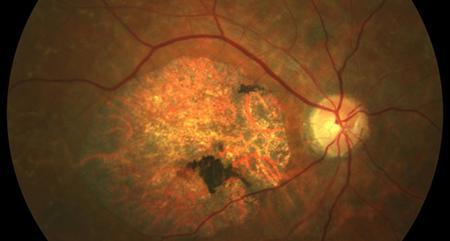
A blurry spot in the centre of vision that gradually grows.
Treatment Perspectives
Although currently the treatment is mainly based on low vision aids, the scientific community is making significant progress. The use embryonic stem cells is currently undergoing clinical trials in major centres in the US and Europe, with early results being very encouraging in terms of halting the disease.
The future is here
Clinical trials with stem cells, which started in the US and expanded to Europe (London), show that science is getting closer to a substantial solution. The first samples from patients undergoing these treatments are very satisfactory, paving the way for preserving vision for future generations.
Frequently Asked Questions
Why does my child have Stargardt while my spouse and I have perfect vision?;
This is because the disease is “recessive”. Both parents may be carriers of the gene without knowing it. When a child inherits the mutated gene from both of you, he or she develops the disease.
Will the disease lead to total darkness?;
No. Stargardt's disease destroys central vision (the ability to see details), but peripheral vision usually remains intact. This means that the patient does not lose the ability to navigate and move around in space.
How do stem cells help in therapy?;
Stem cells have the ability to turn into new, healthy retinal cells. The aim of the trials is to replace damaged macular cells with these new cells to stop the progression of the disease or even improve vision.
Are there glasses that can help?;
Ordinary glasses cannot correct the damage to the retina. However, there are special low vision aids (telescopic systems, electronic magnifiers), which help patients to read and perform daily tasks more comfortably.
Should my child wear sunglasses?;
Yes, it is extremely important. Exposure to ultraviolet (UV) light can accelerate the accumulation of harmful substances in the retina. Children with Stargardt should always wear quality sunglasses that block 100% of UV radiation.
How fast does the disease progress?;
The speed varies from person to person. Usually vision gradually decreases during adolescence and stabilizes at a later level. Regular monitoring helps in the early inclusion of the patient in new clinical studies.