Hyperopia: Anatomical Causes, Adaptation and Therapeutic Solutions
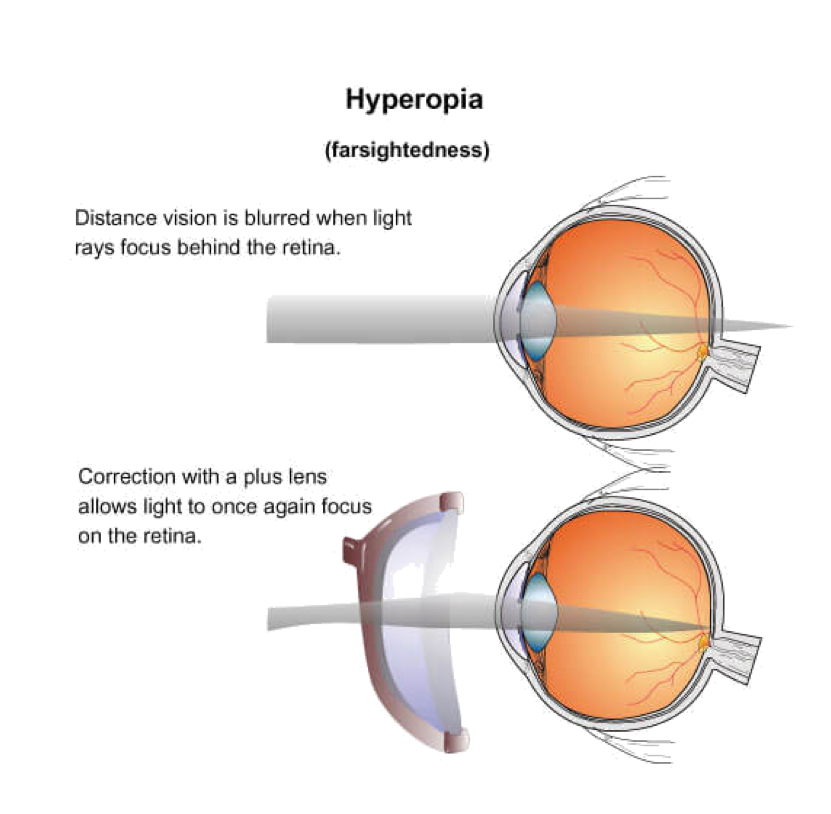
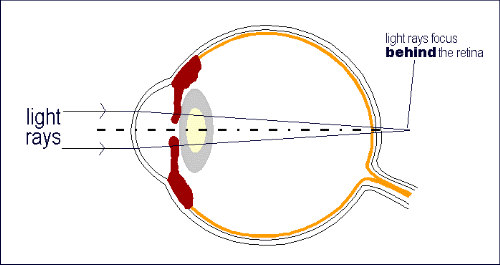
In a hyperopic eye, light rays are focused back from the retina. This is either because the anterior-posterior axis of the eye is smaller than normal (smaller eye), or because the cornea is flatter than normal.
Adaptation & Age
The characteristic of hyperopia is that young people can “counteract” it by using the natural lens of their eye, which changes shape to bring the image to the retina. However, after the age of 40, this ability decreases, making the symptoms more severe.
Diagnosis & Treatment
The diagnosis is made by the procedure of refraction. In children and young people it is necessary to cycloplegia (drops that temporarily “paralyze” the adaptation), in order to measure the actual degree of hyperopia.
The correction is made with:
Converging lenses (glasses or contact lenses).
Refractive surgery (Laser): For adults who want permanent independence from visual aids.
Frequently Asked Questions
What is the difference between hyperopia and presbyopia?;
Although they look alike (both make reading difficult), hyperopia is due to schema of the eye and can be present from birth. Presbyopia is due to aging of the natural lens and occurs in everyone after the age of 45. A hyperopic usually develops presbyopia a little earlier than others.
Why did the doctor put drops on my child to measure it?;
Children have a very strong adaptation. They can “hide” their hyperopia by tightening the inner muscle of the eye. Drops (cycloplegia) relax this muscle, allowing the doctor to see the true degree and not give the wrong glasses.
Can hyperopia cause strabismus?;
Yes. When a child has high hyperopia, the eye “makes an effort” (adaptation) to see clearly. This effort is automatically linked to convergence (the eyes turn inward). Thus, the child may display what we call adaptive internalization.
Will I need glasses forever?;
Many children with mild hyperopia improve as they get older and their eye grows (gets longer). However, in adulthood, as adaptation wanes, most hyperopes need help to see comfortably.
Is Laser effective for hyperopia?;
Yes, modern laser techniques (LASIK, PRK) can correct hyperopia. The procedure “curves” the central cornea more so that the light focuses properly on the retina.
Why do I have headaches when I can see clearly?;
This is very common in hyperopia. You see clearly because your eye is constantly working “overtime” to focus. This constant effort tires the eye muscles and causes headaches, especially at the end of the day or after reading.