
Central Auricular Otropathy (COO): the condition of the young and active
What is it?;
Central Serous Choroidal Retinopathy is a macular condition characterised by the collection of fluid under the retina. It occurs when the melancholic epithelium (the “insulating” tissue of the eye) shows a small leakage. The fluid passes through this crack and lifts the retina, creating a small serous detachment.
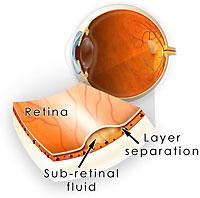
The "Bubbles" Analogy"
You can imagine the condition as a blister on the skin after a burn. Just as fluid collects under the skin, it also collects under the retina, blurring vision in the center.
Who is at risk?;
The disease has a clear preference:
Gender: Men (much more often than women).
Age: Young and middle-aged people (25 to 50 years old).
Profile: People with high anxiety, competitive personality (Type A personality) or people taking cortisone.
What will I feel?;
Blur: Like looking through a stained glass window, right in the center.
Metamorphopsia: Straight lines appear curved or distorted.
Dark Spot: A grey spot that prevents reading.
Therapeutic Approach
The prognosis is usually excellent. In 80-90% of cases, the fluid resolves on its own within 3-6 months without intervention. If the disease persists (chronic form), we intervene with Argon Laser or the newer method of Photodynamic Therapy (PDT) to seal the leak point.
Frequently Asked Questions
I took cortisone for my back and it blurred my eye. Is it related?;
Absolutely. Cortisone use (in pills, injections, ointments or inhaled) is the No. 1 risk factor for the onset or worsening of Central Oedema. If you have been diagnosed with COO, you should tell your other doctors so that cortisone can be discontinued if medically feasible.
How long will it take to see clearly again?;
Central Oroids is a disease that requires patience. Usually the fluid is absorbed over a period of 3 to 6 months. Vision is gradually restored. Some patients may still have a slight disturbance in colour or brightness perception, even when the fluid is gone.
Do I need drops or pills?;
Usually not. There are no drops that “expel” the liquid. On the contrary, cortisone drops are prohibited. In some cases, non-steroidal anti-inflammatory drugs (NSAIDs) may be given, but the main “treatment” is monitoring and stress reduction.
When is Laser needed?;
Laser (or Photodynamic Therapy) is chosen only if:
The liquid is not gone after 4-6 months.
The disease relapses all the time.
The patient needs to be rehabilitated immediately due to his/her occupation (e.g. pilot). The laser targets the leak site and “seals” it.
Is it hereditary?;
It is not considered a classic inherited disease, although there is a genetic predisposition. It is more related to lifestyle, personality (Type A) and cortisol (stress hormone) levels in the blood.
Can it lead to blindness?;
No, it does not cause blindness. However, if left untreated for many years (chronic form), it can cause permanent thinning of the retina and a decrease in central vision (difficulty reading), but peripheral vision remains intact.