
B-Scan: Seeing behind the «blurred» landscape
B-Surgery is an imaging test that allows us to see the inside of the eye in two dimensions (2D), even when direct eye contact is impossible.
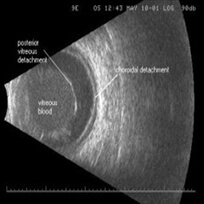
When is it necessary?;
Usually, the ophthalmologist examines the fundus of the eye with light. But when there are «blurred in», such as a very dense cataract or a bleed inside the eye, light cannot pass through. Then, the B-scan provides the solution.
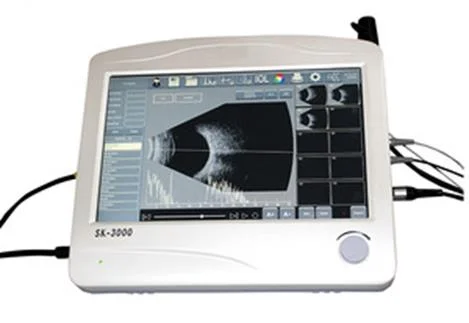
What we test
By using sound waves (as in abdominal ultrasound), we can accurately check:
The condition of the retina (for any detachment).
The optic nerve.
The exalted muscles.
The presence of foreign bodies or shapes behind the eye.
How is it done?;
The test is quick, painless and is usually done with the eyes closed. It allows us to «see» what is happening at the back of the eye, ensuring that the retina and optic nerve are healthy before proceeding with any surgery.
Frequently Asked Questions
Does the eye ultrasound hurt?;
No, not at all. The test is non-invasive. We usually ask the patient to close their eyes and place some special gel on the eyelid. The ultrasound pencil rests gently on the closed eyelid (or sometimes directly in the eye after anaesthetic drops), without causing pain.
Why did the doctor ask me for this test?;
The most common reason is that the doctor cannot see the bottom of your eye clearly with the usual instruments. This may be due to a dense cataract or a bleed. With ultrasound, we make sure that the back of the eye is healthy (e.g., that there is no retinal detachment) before proceeding with cataract surgery.
Does it have radiation? Is it dangerous?;
No. Ultrasound uses high-frequency sound waves, not radiation (like X-rays). It is completely safe and can be repeated as often as needed without risk.
How long does it last?;
It is a very short process. It is usually completed in 5-10 minutes for both eyes.
Will my vision be blurry after the test?;
Not from the ultrasound itself. But if the doctor has had to put drops or gels into the eye, you may have a temporary cloudiness for a few minutes, which quickly subsides once the gel is washed out.
Can I drive afterwards?;
Yes, unless you also have mydriasis (pupillary dilation) for another test at the same visit. The ultrasound alone does not affect your ability to drive.